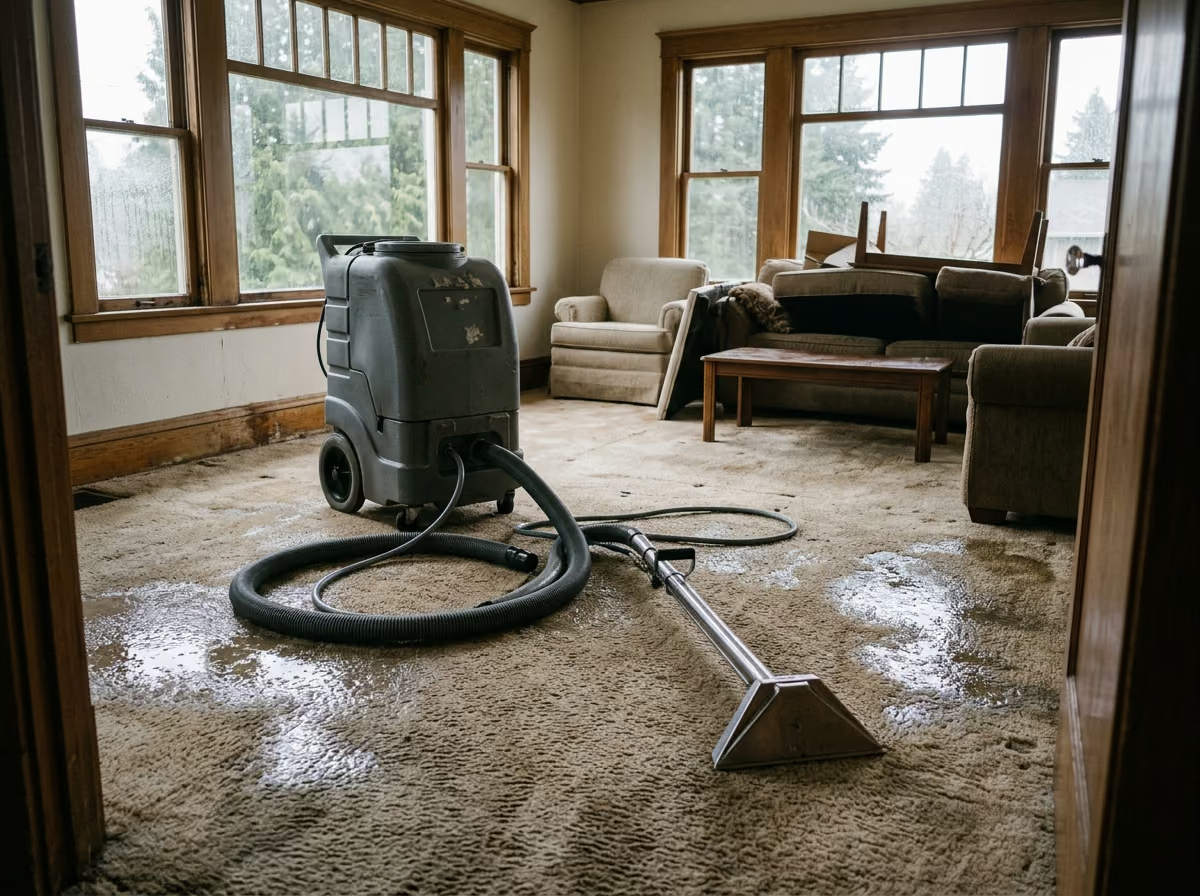
Water in your home right now? Do these three things first
You can do these before anyone arrives. They also protect your insurance claim.

- Stop the water. Shut the main water valve. For a toilet or appliance, close the small valve behind it.
- Stay away from wet electrical. Don't walk into standing water if outlets, cords or the electrical panel might be wet. Turn the power off at the panel only if you can reach it while standing somewhere dry. In Washington, breakers, outlets and switches that were underwater have to be replaced, not dried out (WA L&I).
- Take photos and video before you move anything. Shoot wide shots of every wet room, then close-ups of the water line on walls and the damaged items. Your insurer will rely on that record.
If the water came from a sewer drain, a toilet backup or outside floodwater, keep children and pets out of the area. Sewage is contaminated, and floodwater can be too (more on that below).
Water damage problems covered
Water damage restoration has two parts. Mitigation is the emergency work: removing water, taking out what can't be saved and drying the building. Restoration (or rebuild) puts back the drywall, flooring and trim afterward. Repairs after drying can usually be handled by the same company; ask when you call.
Burst and frozen pipes

Burst pipes are most likely in December and January, when the airport averages about 13 nights a month at or below freezing. Water expands as it freezes, and pressure builds between the ice and the closed faucet, so the pipe often splits away from the frozen spot. The leak can sit unseen inside a wall until it thaws. See burst and frozen pipe water damage.
Flooded basements and crawl spaces

Heavy rain can push water into basements and crawl spaces through foundation cracks and edges. In Nooksack's December 2025 flood, damage ranged from wet crawl spaces to 10 to 20 inches of water inside homes (Cascadia Daily News). See flooded basement cleanup and crawl space water removal.
Sewer backups

Sewage coming up through a floor drain or toilet is Category 3 water, the most contaminated kind. Carpet, pad, drywall and insulation it touched usually have to be removed, not cleaned. See sewage cleanup.
Ceiling, roof, appliance and water heater leaks

Water heaters, dishwashers, washing machine hoses, fridge lines, toilet seals and roof leaks are common sources of indoor water damage. Slow leaks show up as a musty smell, a stain on the ceiling or soft drywall near a tub. See leak water damage.
Mold after water damage

Washington has no state license for mold remediation (WA Department of Health), so ask about training and look up IICRC certification instead. Mold is usually a moisture problem first: until the wet material is dried or removed, it comes back. See mold remediation.
Drying walls, floors and carpet

A household fan can't reach water inside walls, and without a dehumidifier the room just gets more humid. Crews use air movers to speed evaporation from wet materials and dehumidifiers to pull that moisture out of the air. Then they check the walls with moisture meters until they read dry. See structural drying.

Why water damage hits Bellingham homes when it does
Most local water damage comes in two seasons: fall and winter rain, and winter freezes.

Flood season, October through February. Whatcom County's flood season runs from October to February (Whatcom County). November is Bellingham's wettest month, with 5.20 inches in a normal year at the airport (NOAA 1991–2020 normals). In November 2021, back-to-back atmospheric rivers dropped 14.57 inches, nearly three times normal, and the Nooksack River flooded towns across north Whatcom County. When storms arrive a week or two apart, the ground is still soaked from the last one. That's when crawl spaces are most likely to fill and sewers to back up. See Whatcom County flood recovery for flood maps, history and what to do after a flood.
Freezes, December through February. The airport averages about 13 freeze nights in each of December and January. In January 2024, a cold outflow wind took the low to 3°F at the airport (NOAA). Frozen and burst pipes damaged hundreds of homes, apartments and businesses (local news report), and more leaks turned up as temperatures rose (Cascadia Daily News).
Older houses. ZIP 98225 covers downtown, the Lettered Streets, South Hill and Fairhaven. There, 57% of homes were built before 1980 and 28% before 1940 (US Census ACS 2020–2024). In Bellingham, the sewer line from the house to the city main belongs to the property owner (City of Bellingham).
Bellingham's water year
| Month | Rain (in) | Freeze nights |
|---|---|---|
| Jan | 4.49 | 13.3 |
| Feb | 2.85 | 12.2 |
| Mar | 3.36 | 7.4 |
| Apr | 2.77 | 1.9 |
| May | 2.23 | 0.1 |
| Jun | 1.61 | 0 |
| Jul | 0.88 | 0 |
| Aug | 1.13 | 0 |
| Sep | 2.01 | 0 |
| Oct | 3.85 | 1.9 |
| Nov | 5.2 | 8.6 |
| Dec | 4.33 | 13.2 |
What happens after you call
Here is the usual order on a job run by the restoration company your call is connected to. Ask how often you'll get updates while drying runs.

- Inspection and moisture mapping. The crew finds the source and confirms it's stopped. Then they use moisture meters, and often a thermal camera, to trace where the water went inside walls and under floors.
- Photos and readings. Every wet area is photographed and its moisture readings are written down. Your insurer's adjuster relies on this record when deciding what to pay. It also proves when the job is actually dry.
- Water removal. Standing water is pumped or extracted. Wet carpet pad is usually pulled.
- A walkthrough before anything comes out. Ask to be shown what needs to come out, and why, before drywall, flooring or cabinets are removed. The exception is sewage or contaminated floodwater, where some material has to come out right away for safety.
- Drying, checked until dry. Air movers and dehumidifiers run until the materials match the moisture reading of the same material in a dry part of the house. This is called the dry standard.
- Belongings. If rooms need to be emptied, ask about moving and storing belongings.
- Repairs. Repairs can usually be handled by the same company; ask when you call.
Ask who your main contact will be. In the City of Bellingham, emergency repairs can start right away. The permit application is due at the Permit Center on the next business day (City of Bellingham).
Not sure if you need a restoration company? Call (360) 555-0123 and describe what happened.
What water damage restoration costs

How much does water damage restoration cost?
National estimates put most jobs at about $1,400 to $6,400, with an average near $3,800 (HomeAdvisor, 2025 national data; we found no reliable Bellingham-specific average). Four things move the price most. One is how much of the house is wet, and another is whether the water is clean, gray or sewage. The others are how much material has to come out and how many days the drying equipment runs. Most insurers price water damage jobs with Xactimate, estimating software whose price lists are set by area and updated monthly. Ask for a written estimate before any non-emergency work starts. See water damage restoration cost.
Will insurance pay for it?
Sudden leaks inside the house, like a burst pipe, are usually covered. Flood from outside needs separate flood insurance (WA Office of the Insurance Commissioner). See does insurance cover water damage in Washington.
Call (360) 555-0123 to be connected with a local restoration company that can look at the damage.
How this site works
Bellingham Water Damage is a referral service run by Mateo. When you call, a short recorded announcement plays, then you're connected to a local water damage restoration company that serves your area. That company does the work, and we may receive a referral fee. See about this site and how it works when you call. All our guides are listed on the guides page.
Areas covered around Bellingham and Whatcom County

Bellingham's residential ZIP codes are 98225, 98226 and 98229. Calls are connected for Bellingham and all of Whatcom County, including Ferndale, Lynden, Blaine, Birch Bay, Everson, Nooksack, Sumas and Sudden Valley. Each area page covers the water problems specific to that place.
- Lettered Streets and Downtown: some of Bellingham's oldest homes, and sewage and stormwater backups into houses during the December 2025 storms.
- Sudden Valley and Lake Whatcom: outside city limits, so permits come from Whatcom County and electrical permits from L&I, not the City.
- Ferndale: minor flooding starts at 18 feet on the Nooksack's Ferndale river gauge (National Weather Service).
- Everson, Nooksack and Sumas: where Nooksack floodwater can overflow north toward Sumas. These towns flooded in both 2021 and 2025.
- Lynden: a Fishtrap Creek slope failure near 18th Street threatened utilities in December 2025 (Cascadia Daily News).
- Blaine and Birch Bay: king tides and storm surge flooded south Birch Bay Drive on January 7, 2022 (The Northern Light).
- Fairhaven: opening 2,300 feet of Padden Creek in 2015 cut flood risk for 159 Happy Valley homes (City of Bellingham).
- Barkley and Silver Beach: homes along Lake Whatcom, the drinking water source for about half the county (City of Bellingham).
Not on the list? Call (360) 555-0123 and ask. See all service areas.
Landlords, property managers and owners out of town

Over half of Bellingham households rent their home (US Census ACS 2020–2024), so many water damage calls come from landlords and property managers. If you can't be there, ask whether the company can arrange access and send photos and readings while you're away. For rentals built before 1978, removing painted drywall or trim can bring in Washington's lead-safe work rules. Northwest Clean Air Agency rules require checking for asbestos before renovation or demolition in Whatcom County, usually with a survey by a certified inspector. See rental water damage in Bellingham.
Common questions
Is a local company better than a national franchise?
Not automatically. What matters is how fast the company answers and arrives. Check that it's registered with L&I and has IICRC-certified technicians, and that it explains the work and the bill. Check those for any company you call. See choosing a water damage company in Washington.
How long does it take to dry a house after water damage?
There's no fixed number of days. It depends on how much got wet, the materials, and whether water got inside walls or under floors. The crew should take readings until the materials reach the dry standard, and walls shouldn't be closed up until then. See the restoration process and drying times.
Is it safe to stay in the house?
After a clean-water leak, often yes, once the electrical is safe. After a sewer backup or outside floodwater, keep people out of the affected area until it's cleaned and disinfected. See sewage cleanup.
Can I start cleaning up before the insurance adjuster comes?
Yes. Your policy expects you to limit further damage. Stop the water first, then photograph everything before you move or throw anything out, then start drying. Don't make permanent repairs until the adjuster has seen the damage. See insurance claim help.
Should I call a plumber or a restoration company first?
If water is still leaking, shut off the main valve, then call a plumber to fix the pipe. A restoration company handles the water already in the house and the drying. Often you need both, and the drying can start before the repair is finished. See who to call for water damage.
Do I need a permit to repair water damage in Bellingham?
Drying and finish work like paint, carpet and cabinets generally don't need a permit. Cutting open walls, replacing concealed pipe or rewiring does. In an emergency, work can start first, and the City permit application is due the next business day. See Bellingham water damage permits.
Is commercial water damage handled differently?
The drying process is the same. Commercial jobs usually just need more equipment. For a business or commercial building, mention it when you call.